
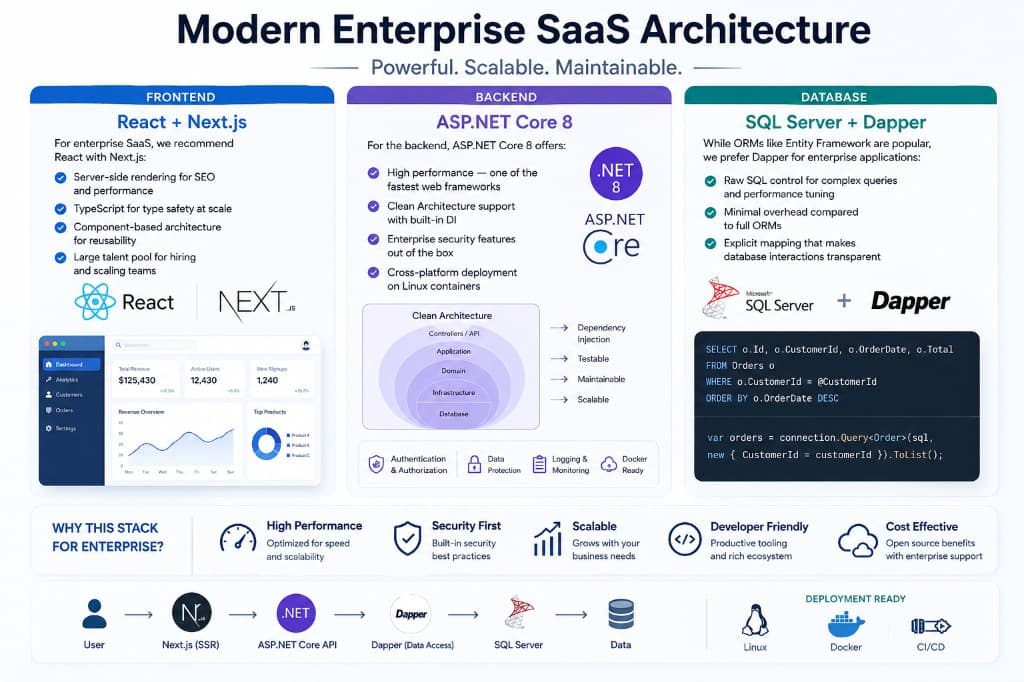
Selecting the right technology stack is one of the most critical decisions when building an enterprise SaaS product. The wrong choice can limit scalability, increase costs, and make hiring difficult.
Frontend: React + Next.js
For enterprise SaaS, we recommend React with Next.js:
- Server-side rendering for SEO and performance
- TypeScript for type safety at scale
- Component-based architecture for reusability
- Large talent pool for hiring and scaling teams
Backend: ASP.NET Core 8
For the backend, ASP.NET Core 8 offers:
- High performance — one of the fastest web frameworks
- Clean Architecture support with built-in DI
- Enterprise security features out of the box
- Cross-platform deployment on Linux containers
Database: SQL Server + Dapper
While ORMs like Entity Framework are popular, we prefer Dapper for enterprise applications:
- Raw SQL control for complex queries and performance tuning
- Minimal overhead compared to full ORMs
- Explicit mapping that makes database interactions transparent
When to Choose Alternatives
Every project is different. Consider alternatives when:
- You need real-time features at massive scale (consider event-driven architecture)
- Your team has deep expertise in a different stack
- Regulatory requirements mandate specific technologies
Our Recommendation
For most enterprise SaaS products targeting B2B clients, the React + ASP.NET Core + SQL Server stack provides the best balance of performance, maintainability, and talent availability.
See our SaaS product development services and live Academic ERP platform, or get in touch to discuss your stack.
Deployment and DevOps Considerations
Enterprise SaaS must deploy reliably across environments. Containerized ASP.NET Core APIs deploy cleanly to Linux hosts, Azure, or AWS. Next.js frontends fit naturally on Vercel or similar edge platforms. SQL Server remains the proven choice for transactional workloads with strong consistency requirements.
CI/CD pipelines should run type checks, linting, and automated tests on every pull request. Infrastructure-as-code keeps staging and production aligned. Feature flags help roll out changes gradually to enterprise customers who cannot tolerate downtime.
Team Structure and Hiring
Your stack choice affects hiring velocity. React and .NET both have large talent pools globally, making it easier to scale teams than niche frameworks. TypeScript on the frontend and C# on the backend give you strong typing on both sides of the stack, reducing integration bugs between UI and API teams.
Performance at Scale
Dapper gives you predictable query performance for reporting dashboards and batch operations. Next.js SSR improves first-load experience for marketing and authenticated portals alike. Caching strategies at the API and CDN layers keep response times low as user counts grow.
Security Baseline
Enterprise buyers expect JWT authentication, role-based authorization, audit logging, and encrypted transport. ASP.NET Core ships with mature middleware for these concerns. Pair it with Cloudflare Turnstile or similar bot protection on public forms and rate limiting on APIs to control abuse.
Making the Decision
Document your non-functional requirements first: expected user count, compliance needs, integration list, and team skills. Score candidate stacks against those requirements rather than hype. For most B2B SaaS products serving mid-market and enterprise clients, the React + ASP.NET Core + SQL Server combination remains a dependable default.
Want a second opinion on your architecture? Book a consultation with the Amlogics engineering team.